Structural context · Regulatory data
Short interest that admits how old it is
Short interest is regulatory data: FINRA collects it twice a month and publishes it about two weeks later. Fails-to-deliver run six weeks behind. That delay is a property of the source — so instead of hiding it, our tracker prints the settlement date and the data's age on every row.
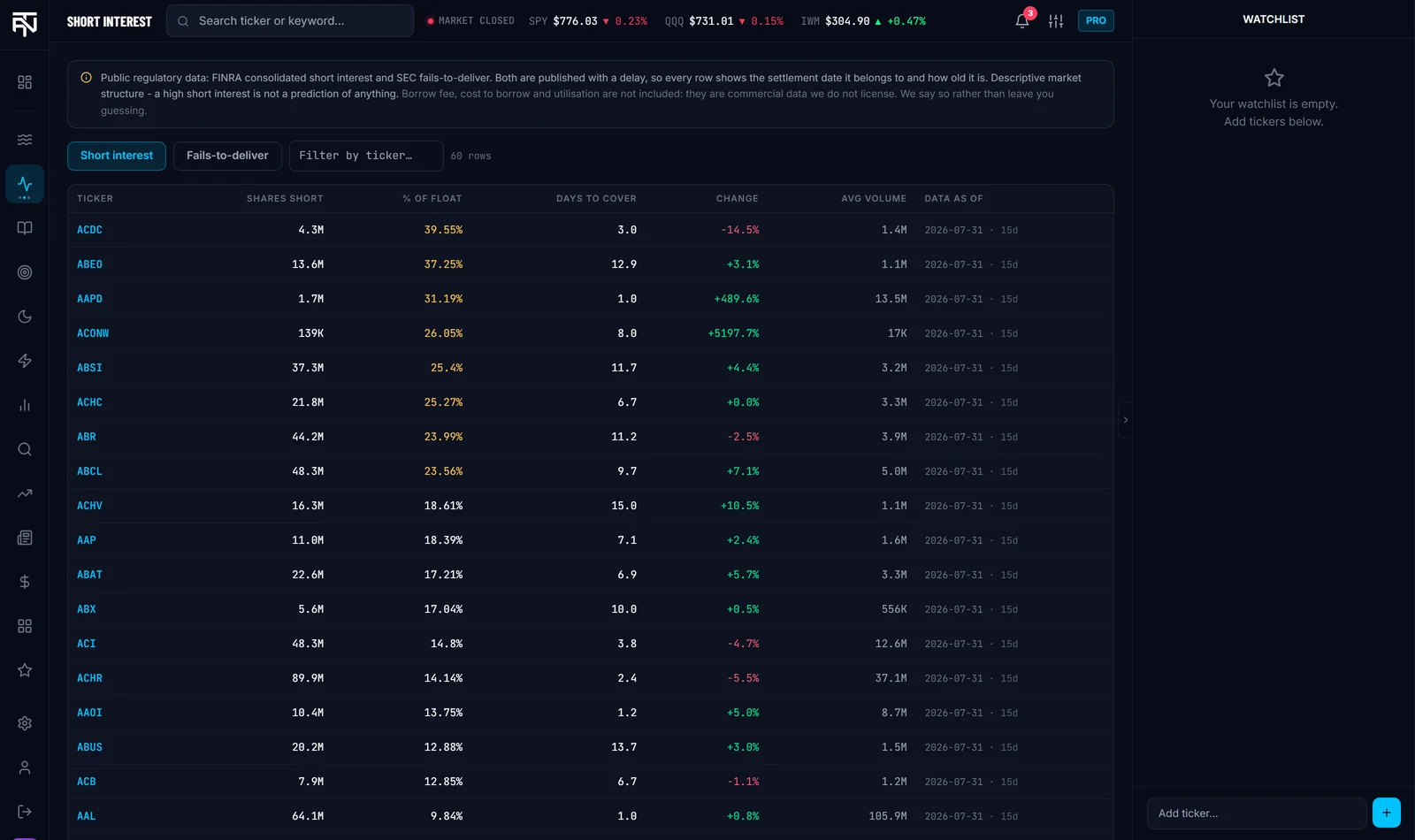
Short interest, FTD and insider context for a real ticker — public, no login.See a real per-ticker page: AAPL →
What you get
Shares short, % of float, days to cover
The full FINRA consolidated file each cycle, joined with free-float data so the ratios are computed, not guessed.
Cycle-over-cycle change
How the aggregate short position moved versus the prior settlement — growth and covering both visible.
Fails-to-deliver volumes
The SEC’s twice-monthly FTD files per ticker, with price and description, dated like everything else.
As-of on every row
Settlement date and age, per row, with rows older than 30 days visually flagged. The tooltip explains the publication lag in plain words.
THE DETAIL THAT MATTERS — every row is dated
TICKR · 18.2M shares short · 21.4% of float · 3.1 days to cover · settlement 2026-07-31 · 15d old
Illustrative row. In the dashboard, every figure carries its real settlement date from the FINRA or SEC file it came from.
HOW THIS IS CALCULATED
Short interest: FINRA consolidated short interest file, reported by broker-dealers for twice-monthly settlement dates and published ~2 weeks after each. Fails-to-deliver: SEC half-month files, published with ~6 weeks of delay. Free float for the %-of-float ratio: Financial Modeling Prep. Days to cover: shares short ÷ average daily volume. These are descriptive positions and ratios — not predictions, and never presented as live.
Frequently asked questions
Where does the short interest data come from?
From FINRA’s consolidated short interest file, which broker-dealers are required to report twice a month. FINRA publishes roughly two weeks after each settlement date, so the data is inherently delayed — which is exactly why every row in our tracker displays its settlement date and its age instead of implying the number is current.
What are fails-to-deliver (FTD) and why track them?
A fail-to-deliver occurs when a party does not deliver shares by settlement. The SEC publishes FTD files twice a month with roughly a six-week delay. Persistent, elevated FTDs on a ticker are a structural data point about settlement friction on that name. Like everything on the platform, we present them as attributed regulatory records with their as-of dates — not as a prediction of what the stock will do.
What do % of float and days to cover mean?
% of float is shares sold short divided by the free float — the share supply actually available for trading. Days to cover divides shares short by average daily volume: how many typical sessions of buying it would take to cover the entire short position. Both are descriptive ratios of the current aggregate position; float data comes from Financial Modeling Prep.
Does high short interest mean a short squeeze is coming?
No. High short interest describes a large aggregate short position; it says nothing about when or whether that position will be forced to cover. Famous squeezes had high short interest, but so do many stocks that simply decline. We show you the measured structure and its dates — we do not turn it into a forecast, on principle and by policy.
How fresh can this data possibly be?
As fresh as the regulators publish it: FINRA short interest arrives about two weeks after each twice-monthly settlement; SEC FTD files arrive in half-month batches roughly six weeks behind. Any product implying real-time short interest is misrepresenting the source. Our tracker shows the settlement date and age on every single row, and flags rows older than 30 days.
The aggregate short position, dated and honest
Short interest, FTDs and the rest of the structural triad live in the dashboard on the PRO plan.
Not financial advice. Trading involves risk. TradeAI News provides structural market context, not directional recommendations.
Last updated August 27, 2026