TRADEAI NEWS
PlatformPricingGet started
HomePlatformContext Journal
The moat · Journal

A trade journal that remembers what the market was doing

Every journal on the market can tell you your win rate. None of them can tell you your win rate in negative gamma, or how you perform on earnings days versus quiet tape— because they never captured the market's state at your entry. TradeAI News does: each trade freezes the structural context that surrounded it, permanently.

What gets frozen with every trade

Context layerWhat it capturesWhere it comes from
Gamma regimeNet GEX and distance to the gamma flip of the reference index at your entry timefrom our own GEX engine, snapshotted every 5 minutes
News catalystThe active catalyst on the ticker (earnings, FDA, M&A, analyst action…) when you enteredfrom the catalyst engine
Macro calendarCPI, FOMC, NFP and other macro events scheduled for that sessionfrozen at capture — never rewritten
Market regimeTrend and volatility state of SPY/QQQ around your entrycomputed, labeled, stored
Price structureYour entry versus VWAP, day range and 1-minute excursion (MFE/MAE)from minute bars
BehaviorRe-entries after a loss, order-in-day patterns, hold-time asymmetriesfrom your own fills
REPRESENTATIVE SAMPLE — what a frozen context card looks like
LONG US100 · closed +0.42%
GAMMA
NDX net GEX negative · spot 1.2% below the flip
CATALYST
None active on ticker · CPI printed 08:30 ET
REGIME
SPY downtrend day · elevated realized vol
STRUCTURE
Entry 0.3% under VWAP · MFE +0.71% · gave back 41%

Sample shown with illustrative values. In the dashboard, every card is built from your real fills and our recorded market data, and shows its capture timestamps.
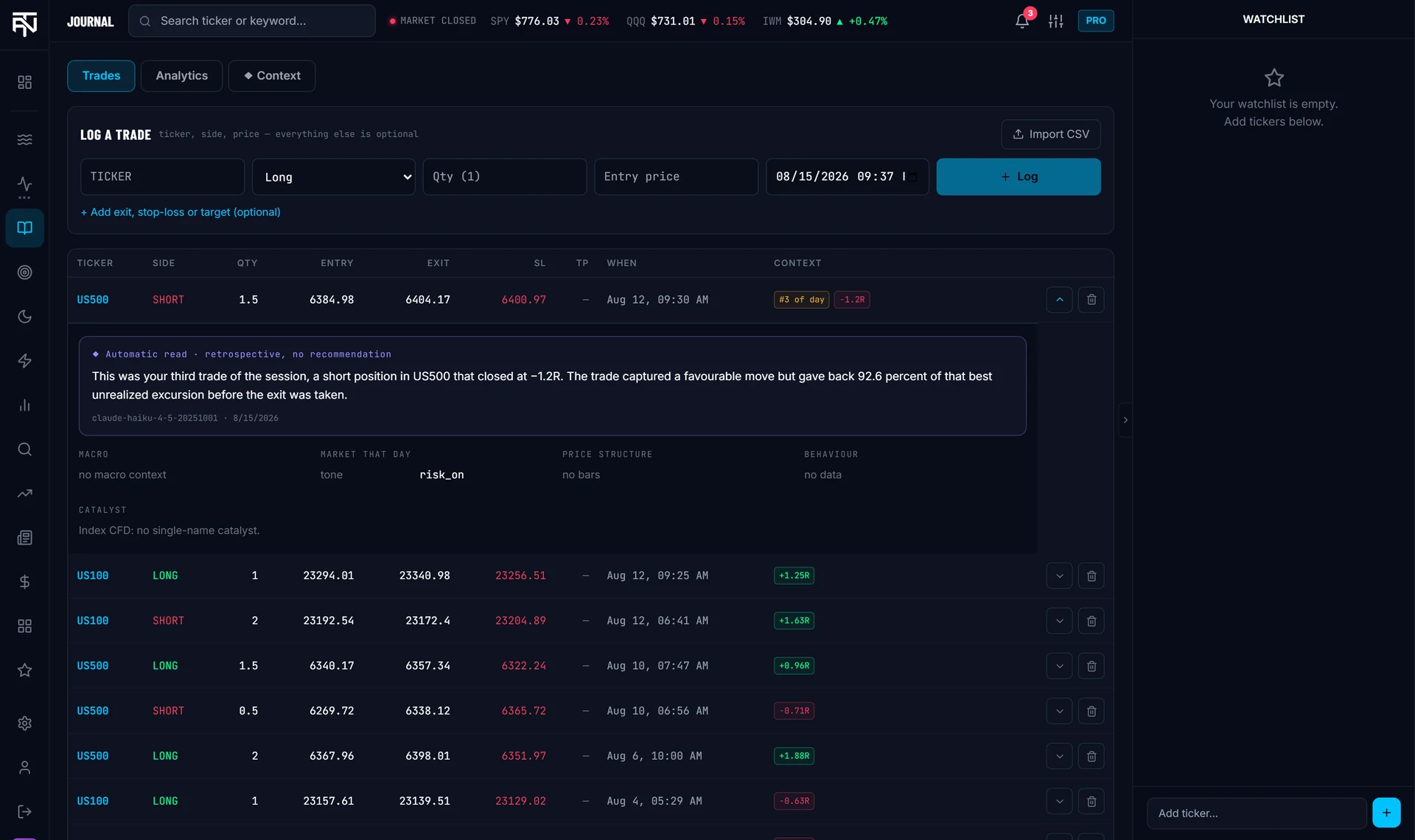
Context Analytics: the questions only this journal can answer

Because the context is stored per trade, the analytics can aggregate across it. The ◆ Context Analytics tab crosses your P&L against market regime, catalyst type, MFE give-back, R-multiple distribution, revenge re-entries and overtrading — and, as gamma context accumulates on your new trades, against gamma regime and distance to the call/put walls. Blocks that do not have enough data yet say so, with the exact reason.

P&L by market regime
Are you actually better on trend days, or does it just feel that way? The buckets answer with n, win rate and P&L per regime.
MFE give-back
How much of your maximum favorable excursion you hand back before exit — the most expensive habit most traders never measure.
Behavioral flags
Re-entries within minutes of a loss, and performance by trade order within the day, computed from your own fills.
AI retrospective note
A per-trade written read of the frozen context — strictly retrospective, checked by a deterministic non-directional guardrail before it reaches you.
HONESTY RULES BUILT INTO THE JOURNAL
Context is frozen at capture and never backfilled with hindsight. CFD instruments are labeled as proxies of their reference index, not passed off as the index itself. Aggregations declare their minimum sample and show thin buckets dimmed. Deposits and withdrawals are tracked separately from P&L, so a deposit never inflates your return. The AI note is retrospective by construction and fails closed: if a generated note trips the non-directional guardrail, it is discarded.

Frequently asked questions

What does "market context" mean in a trade journal?
Every trade you log (or import) is enriched with the market conditions that existed at your entry: the gamma regime of the underlying index, the news catalyst active on the ticker, the macro calendar events of that session, the broader market regime (trend and volatility of SPY/QQQ), and the price structure around your entry from 1-minute bars. That context is frozen at capture time — it does not get rewritten later, so what you review is what actually surrounded the trade.
How is this different from Tradervue, Edgewonk or TraderSync?
Execution-focused journals analyze what you did: win rate, hold time, position size. They cannot tell you what the market was doing around each entry, because they never captured it. TradeAI News runs its own gamma-exposure engine, catalyst detection and macro calendar, so the journal can cross your performance against variables an execution-only journal cannot see — for example, your P&L split by gamma regime or by catalyst type.
Does it import trades from my broker?
Yes. You can import CSV and XLSX exports (including XTB), and re-importing the same file backfills P&L and fees without duplicating trades. Index CFDs such as US100 or US500 are mapped to their reference indices for context, and the journal is explicit about that proxy relationship rather than pretending a CFD is the index.
What is the AI retrospective note?
An automatically generated, retrospective reading of each closed trade: what the frozen context showed and how the trade unfolded within it. It is strictly non-directional by design — a deterministic guardrail checks every note and blocks any sentence that looks like advice, a prediction, or a recommendation. Notes that fail the check are discarded, not softened.
What happens when I have very few trades?
The analytics tell you. Aggregations that need a minimum sample show exactly how many trades you have versus how many they need, instead of drawing confident charts from three data points. Thin buckets are visually flagged. We would rather show you an honest empty state than a misleading statistic.
Is the journal giving me trade advice?
No. The journal and its analytics are retrospective and structural: they describe what happened and the conditions around it. Nothing in the product tells you what to buy, sell, or predict. That is a deliberate legal and philosophical position — see our page on why we do not sell trading signals.
The platform: one context layerGamma Exposure engineAnalyst Accuracy trackerWhy we don’t sell trading signalsPricing

Your next trade deserves its context

Import your history, and every new trade starts freezing market structure from day one.

Start free →View all plans →

Not financial advice. Trading involves risk. TradeAI News provides structural market context, not directional recommendations.