Structural context · SEC filings
Insider trades, minus the compensation noise
Raw Form 4 feeds bury the interesting filings under stock grants, option exercises and tax withholding — compensation plumbing, not decisions. Our tracker defaults to open-market purchases and sales only (codes P and S), shows who traded and their role, how late they filed, and links every row to the original filing on SEC.gov.
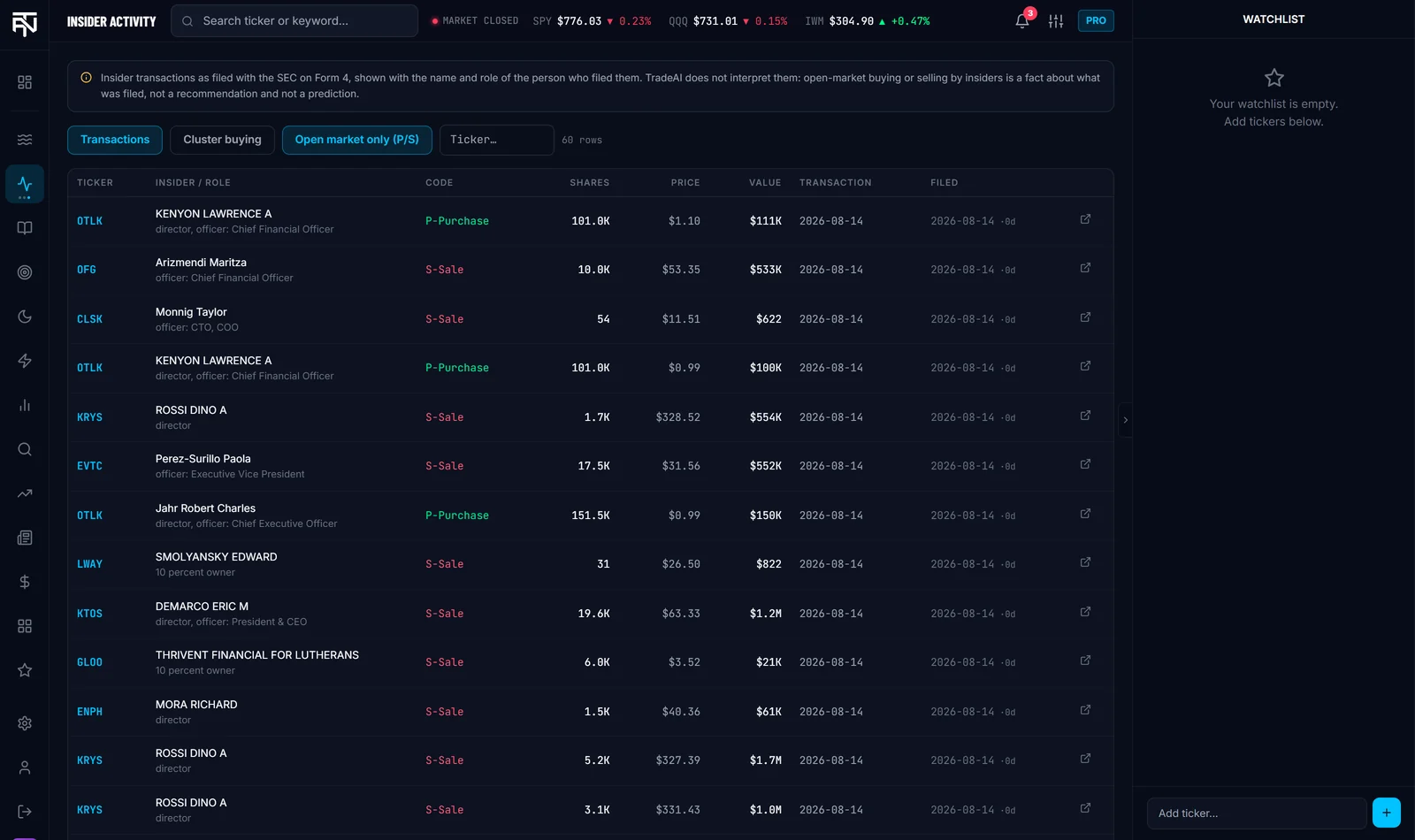
A real per-ticker page with Form 4 context — public, no login.See AAPL’s insider activity →
What you get
Open-market view by default
Codes P and S — trades where an insider chose to commit or withdraw their own money. The all-codes view is one toggle away, with each code explained.
Cluster-buying detection
Tickers where several distinct insiders bought on the open market within 30 days, with share and dollar totals. Two-person clusters are flagged as indicative.
Attribution and filing lag
Name, role, shares, price and value per transaction — plus how many days after the trade the Form 4 was actually filed.
Source links to SEC.gov
Every row links to the underlying filing. If you want to verify a number, the primary source is one click away.
WHAT A ROW CARRIES
TICKR · Jane Doe, CFO · P — open-market purchase · 25,000 shs @ $14.20 · $355K · filed +1d · Form 4 ↗
Illustrative row with a fictional name. Real rows show the actual filer, role and SEC.gov link from the Form 4 itself.
HOW THIS IS CALCULATED
Source: SEC Form 4 filings via Financial Modeling Prep’s insider-trading feed. Default filter: transaction codes P and S (open-market). Cluster: ≥2 distinct insiders buying the same ticker within a 30-day window; 2-person clusters labeled indicative. Validation: records whose transaction date post-dates their own filing (vesting artifacts) are excluded. This is attributed public data, shown descriptively — we do not score it, rank it as a buy list, or attach predictions to it.
Frequently asked questions
What is a Form 4 and why does it matter?
A Form 4 is the SEC filing that corporate insiders — officers, directors and 10%+ owners — must submit within two business days of trading their own company’s stock. It is public, attributed data: you see who traded, their role, how many shares, and at what price. When someone who runs the company puts their own money into it on the open market, that is a fact worth seeing in context.
Why filter to open-market transactions (codes P and S) by default?
Because most Form 4 activity is not a decision to buy or sell at all. Stock grants, option exercises and tax-withholding dispositions are compensation mechanics — in our ingested sample, roughly one in five records is that kind of accounting noise. The default view keeps transaction codes P (open-market purchase) and S (open-market sale), where an insider actually chose to trade. A toggle shows everything, with each code’s meaning spelled out.
What is cluster buying?
Multiple distinct insiders buying the same stock on the open market within a 30-day window. One insider buying can mean many things; several officers and directors independently buying with their own money is a stronger aggregate fact. Clusters of only two people are flagged as indicative — a hint, not a trend. It remains a description of what insiders did, not a forecast of what the stock will do.
How current is the data?
Form 4s are due within two business days of the transaction, and we show the filing lag per row — a purchase filed 40 days late (it happens) is visibly different from one filed the next morning. Each row links to the original filing on SEC.gov, so every number can be checked at the source. We also validate the records: transactions dated after their own filing (vesting-schedule artifacts) are excluded.
Does insider buying mean the stock will go up?
No. The academic evidence on insider purchases is interesting but noisy, and any single filing can reflect diversification, taxes, or optics. We present Form 4 data as attributed public records with honest filters — structural context for your own analysis, never a recommendation. That framing is a policy across the entire platform.
See who is buying their own company
The full Form 4 feed, cluster view and per-ticker history live in the dashboard on the PRO plan.
Not financial advice. Trading involves risk. TradeAI News provides structural market context, not directional recommendations.
Last updated August 26, 2026